The Maintenance Debt Bubble: Why We Built Flipturn
The Decoupling of Creation and Maintenance
The speed of software creation has finally decoupled from the speed of software maintenance. We are not prepared for the fallout.
The industry is currently intoxicated by "Velocity." With the rise of "Vibe Coding"—powered by Cursor, Claude, and Copilot—the friction between thought and commit has effectively vanished. We are witnessing a 10x explosion in feature delivery.
But as a Principal Engineer who has spent a career in the trenches of machine learning & distributed systems, I see a darker shadow being cast: We are inflating an exponential Maintenance Debt Bubble.
This is the hidden, compounding accumulation of code volume that expands the surface area for failures, alerts, security drift, and cognitive overload. We are generating code at a rate that has far outpaced the biological capacity to reason, debug, and sustain it.
The Velocity Mirage
For decades, there was a natural "governor" on system complexity: human typing speed and the cognitive load of manual refactoring. AI has removed that governor.
When you can generate a microservice in thirty seconds, you aren't just adding a feature; you are adding a permanent tax on your SRE team. Every line of AI-generated code is a liability that requires monitoring, patching, and mental mapping. The relationship between Lines of Code Written and Human Ability to Maintain is no longer linear. It is diverging.
We are building massive, sprawling architectures that no single engineer—or even a team of engineers—can fully keep in their head. Like all bubbles, this one is predicated on the false belief that we can manage infinite growth with finite human attention.
Quantifying the Silent Crash
The cost of this bubble isn't just "technical debt" in the abstract; it is a quantifiable drain on the modern enterprise.
| Dimension | The Hidden Tax | Realistic Impact |
|---|---|---|
| Engineering Cost | Lost hours to context switching and on-call burnout. | 20% increase in dev churn; $200k+ per replacement. |
| Financial Cost | MTTR (Mean Time to Recovery) expansion. | At $5k/min of downtime, a 30-min delay costs $150,000. |
| Cognitive Load | The "Shadow Surface Area" of unmapped code. | Seniors spend 60% of their time "investigating" vs. building. |
In sectors like Fintech, this bubble manifests as "silent bugs"—edge cases in payment logic that pass unit tests but fail under high-concurrency L3 spikes. In HealthTech, it's "data drift" where PII exposure occurs because a generated module didn't respect isolation boundaries.
The Upcoming Reliability Crisis
In the next 2–5 years, the next great reliability crisis will not be caused by "bad engineers." It will be caused by too much code.
We will reach a point where the volume of alerts generated by our observability stacks—Datadog, Sentry, OpenTelemetry—will exceed the biological limits of the SREs tasked with triaging them. We are heading toward a "Mechanical Symbiosis" failure where the tools observe the system, but no one understands the system.
Why Our Current Tools are Insufficient
We have the best observability tools in history, but observability is not cognition.
- Datadog gives us metrics.
- Sentry gives us stack traces.
- OTel gives us traces.
A dashboard can tell you that your database pool is exhausted. It cannot tell you why a specific PR from three weeks ago, generated by an AI, created a latent connection leak that only triggers during a specific user journey. Current tools observe state; they do not understand behavior.
The Necessary Shift: From Dashboards to Cognition
The industry must move from Passive Observability to Active System Cognition.
| Old World (Observability) | New World (System Cognition) |
|---|---|
| "What is happening?" | "Why is this happening?" |
| Visualizing logs and spikes. | Correlating logs to code intent. |
| Counting errors. | Diagnosing root causes autonomously. |
Why Flipturn Exists
I didn't start Flipturn to build another "AI wrapper." I started it out of a deep, personal frustration. I've watched brilliant teams drown under the weight of invisible debt. I've seen SREs spend weekends staring at log-storms that an intelligent system should have diagnosed in seconds.
Flipturn exists to be the Nervous System for the Maintenance Debt Bubble.
We are building an Autonomous Causal SRE Platform that bridges the gap between "Observing" and "Understanding." By architecting a multi-agent orchestrator that reasons through infrastructure symptoms (e.g. Datadog alerts), application DNA (e.g. Sentry logs), high-fidelity traces of OpenTelemetry, and customer signals to autonomously synthesise the RCA (root cause analysis) and provides a safe-mode remediation battle-card for your high-velocity engineering teams.
Flipturn Architecture
Flipturn is engineered as a coordinated, four-stage architecture where specialized components work in harmony to move from passive observation to active cognition.
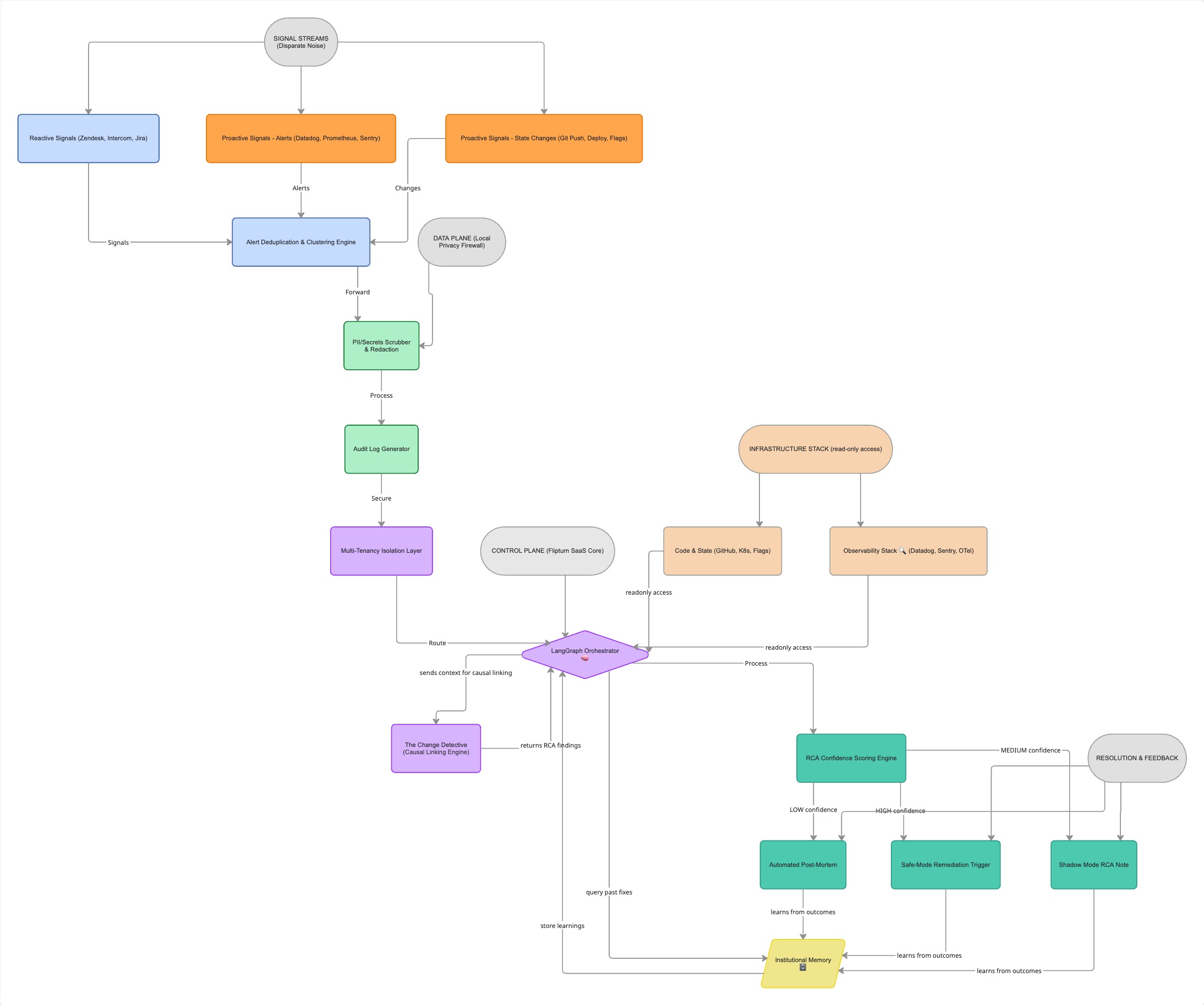
1. The Signal Streams (Disparate Noise)
Flipturn acts as an intelligence layer that bridges your existing stack. We ingest:
- Reactive Signals: Zendesk or Intercom tickets (customer-reported issues).
- Proactive Signals: Datadog/Prometheus alerts, Sentry error events, and GitHub deploy events.
2. The Sovereign Trust Gate (Local VPC)
Our non-negotiable gate for security is the Sovereign Privacy Firewall. Before any data reaches our SaaS "brain," a local scrubber redaction layer ensures sensitive PII never leaves the data plane perimeter.
- Regional-Aware Sanitization: We redact both global PII and region-specific identifiers (Aadhar, PAN, UPI) at the source.
- Data/Control Plane Decoupling: This strict isolation ensures raw infrastructure data is never exposed to the reasoning layer, ensuring zero-leak security.
3. The Autonomous Brain (SaaS Core)
The heart of Flipturn is a LangGraph Orchestrator that executes a coordinated investigation across your entire stack:
- Causal DNA Correlation: While traditional tools provide correlation, our Change Detective identifies causality. It links infrastructure symptoms (Datadog) with service-level application DNA (Sentry) and high-fidelity traces (OpenTelemetry) to pinpoint the exact Git commit or Feature Flag toggle responsible.
- Institutional Memory (The RAG Moat): As incidents are resolved, Flipturn indexes them into a specialized knowledge base, developing an "intuition" for your unique codebase that generic models cannot replicate.
4. The Resolution (Closed Loop)
Flipturn doesn't just "chat"; it closes the loop:
- Shadow Mode RCA: Generates passive root cause analysis notes in real-time.
- Safe-Mode Remediation: Triggers active remediation to prevent cascading failures.
- Self-Hardening Loop: Drafts post-mortems for your systems of record, ensuring your infrastructure literally becomes more resilient the longer Flipturn is active.
Flipturn in Action
Flipturn is built on six foundational components working in harmony:
- Sovereign Privacy Firewall: Total separation of data and control planes for zero-leak compliance.
- Causal DNA Correlation: Real-time linking of infrastructure symptoms with application DNA.
- Closed-Loop Resolution: Full incident lifecycle automation, from detection to Zendesk/Jira/Intercom updates.
- Autonomous Agentic Orchestrator: Merging real-time signals with system-of-record remediations via LangGraph.
- Proactive OTel Daemon: Moving from "Waiting for a Ticket" to "Predicting the Fix" via OpenTelemetry subscriptions.
- Resilient Event Bus: A provider-agnostic, plug-and-play architecture for any cloud stack.
Watch how we move from 45 minutes of manual firefighting to 10 seconds of autonomous clarity with Flipturn's Autonomous L3 Agent.
Flipturn's Autonomous L3 Agent eliminates the "Incident Fog of War" by executing a coordinated investigation across your entire stack:
- 🛡️ Sovereign Trust Gate: Local PII scrubbing (emails, IPs, names) ensures sensitive data never leaves the data plane perimeter.
- 📊 Infrastructure "What" (Datadog): Autonomously identifies symptoms like database pool exhaustion or latency spikes.
- 🧬 Application "Why" (Sentry): Pivots to code DNA to pinpoint exact stack traces and hidden logic errors.
- 🧠 Autonomous Synthesis: A LangGraph AI Orchestrator correlates these signals into actionable Zendesk notes with clear remediation steps.
An Invitation
I don't have all the answers. The problem of AI-generated complexity is one of the greatest challenges our generation of engineers will face. But I know this problem is real, and I refuse to watch our industry drown under the weight of its own creation.
We are looking for 5 Design Partners—SREs, Platform Leaders, and CTOs—who are feeling the weight of the bubble and want to help us shape the future of autonomous reliability.
Let's build a system that understands the code, so we don't have to spend our lives just maintaining it.
Ready to see Flipturn in action? Request access to join our design partner program.
Want to eliminate incident firefighting?
Join teams using Flipturn for autonomous root cause analysis.
Request Access